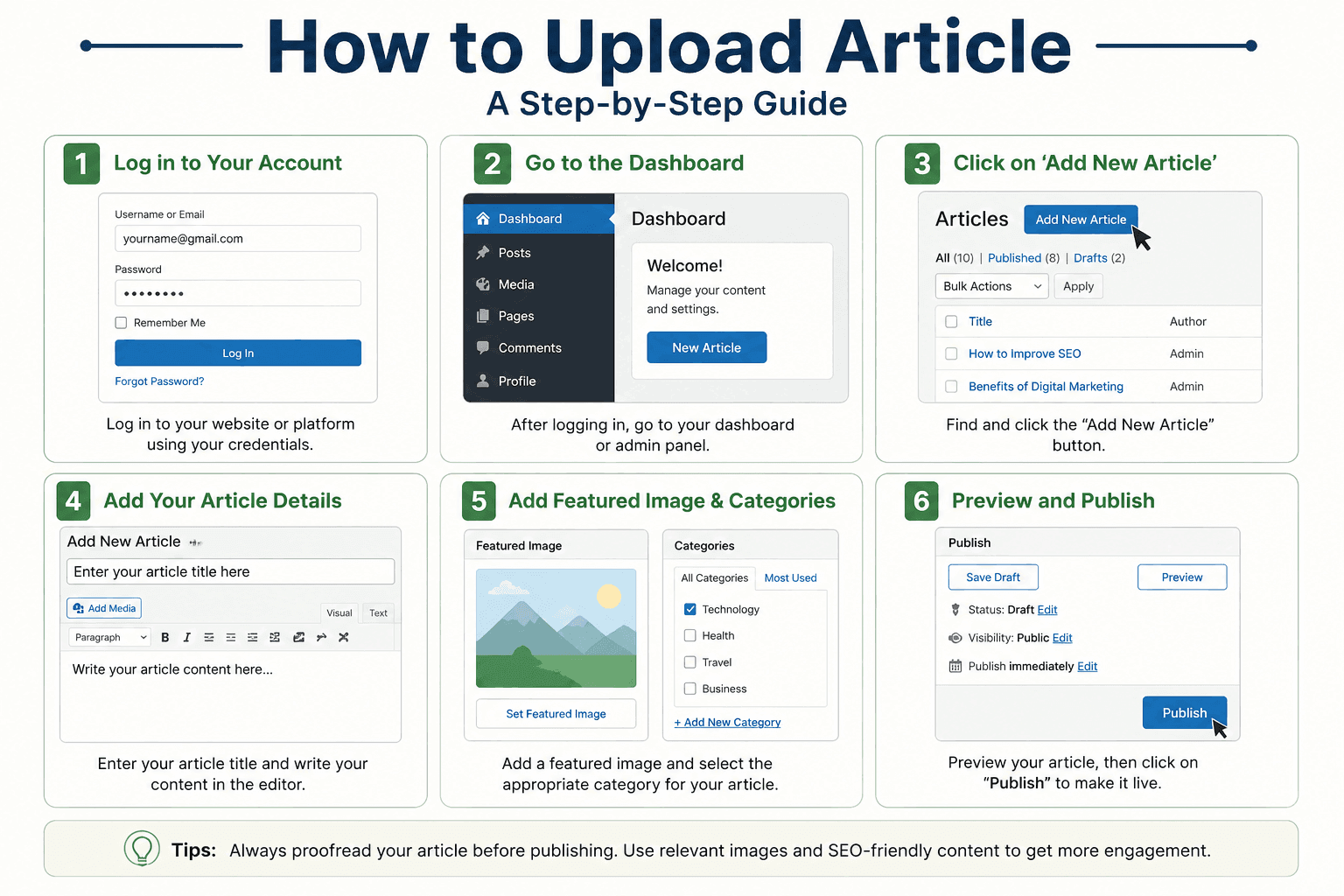
Why the Way You Uploadarticle Matters for Your Brand
The first thing to understand is that the act of an uploadarticle is a direct reflection of your brand’s professionalism.
If you upload a piece of content that is riddled with formatting errors, broken links, or low-resolution images, your audience will subconsciously associate that lack of care with your products or services.
On the other hand, a perfectly uploaded article—one that looks beautiful on both mobile and desktop—signals that you are an authority in your field.
This is why you cannot rush the final stage of content creation.
The “upload” phase is where your hard work is polished and presented to the public, and it deserves just as much time as the writing itself.
Furthermore, the technical details hidden within the uploadarticle process are what tell search engines like Google what your page is about.
From the metadata to the alt text on images, every field you fill out serves as a signal. If you skip these steps, you are essentially burying your content in the backyard.
Proper uploading ensures that your article is indexed correctly, allowing it to appear in front of people who are actively searching for the topics you cover.
It is the bridge between your private ideas and the global marketplace of information.
Preparing Your Content Before You Hit the Upload Button
Before you even log into your Content Management System (CMS) to uploadarticle, you must ensure your draft is truly ready.
This means performing a deep dive into grammar, tone, and factual accuracy. Nothing kills the momentum of a newly published article like a typo in the first paragraph.
I always recommend using multiple tools to check your work, but more importantly, read it out loud.
Reading your work aloud helps you catch awkward phrasing that a digital spellchecker might miss. This preparation phase is the foundation of a successful upload because it ensures the substance of your work is high-quality.
Additionally, you should have all your assets ready in a single folder. When you upload an article, you don’t want to be hunting for image files or source links in the middle of the process.
Rename your images to reflect your focus keywords, such as “uploadarticle-guide.jpg,” instead of leaving them as “IMG_1234.jpg.”
This small step is a secret weapon for SEO.
Having your links, images, and text organized allows for a smooth, linear upload process that minimizes the chance of making technical mistakes or forgetting a key component of the post.
Choosing the Right Platform to Upload Your Article for Your Needs
Where you choose to upload your article is just as important as what you write. Different platforms cater to different audiences.
For instance, if you are looking for professional networking and B2B engagement, LinkedIn is a fantastic place to publish articles.
If you want full control over your design and long-term SEO, a self-hosted WordPress site is usually the gold standard.
Medium is great for those who want a built-in audience without worrying about the technical backend.
Each platform has its own set of rules for how to best uploadarticle, and understanding these differences is key to maximizing your reach.
For most businesses, the goal is to drive traffic back to their own website.
In this case, your primary uploadarticle activity should happen on your own domain. This builds “domain authority,” which makes your entire website more likely to rank high in search results.
However, you can also “repurpose” your content by uploading summaries or variations to other platforms.
This multi-channel approach ensures that no matter where your target audience spends their time, they have a chance to encounter your expertise and click through to your main hub.
The Role of Headlines in the Uploadarticle Process
When you finally begin to uploadarticle, the headline is the most critical field you will fill. It is the “front door” of your content.
A weak headline means nobody enters, no matter how great the party inside is. Your headline should be a mix of curiosity and clarity.
It needs to contain your focus keyword, like “uploadarticle,” but it also needs to promise a benefit to the reader.
Think about the difference between “How to Upload an Article” and “The Ultimate Guide to Uploadarticle for Maximum Traffic.”
The second one is much more compelling because it tells the reader exactly what they will gain.
From an SEO perspective, the headline usually becomes the H1 tag and the Page Title.
These are the most weighted elements for search engines. When you uploadarticle, make sure your CMS isn’t adding unnecessary words to your title.
Keep it under 60 characters if possible so that it doesn’t get cut off in Google search results.
A well-crafted headline not only attracts clicks but also sets the tone for the entire reading experience, making it easier for the audience to digest the information you are about to provide.
Formatting Your Text for Digital Consumption
One of the biggest mistakes people make when they uploadarticle is keeping the text in long, dense blocks. On the web, people don’t read; they scan.
To make your article user-friendly, you must use frequent subheadings, bullet points, and short paragraphs.
This creates “white space,” which makes the content feel less overwhelming.
When you uploadarticle, try to keep your paragraphs to no more than three or four sentences. Use bold text to highlight key points, but don’t overdo it, or the page will look cluttered and distracting.
Subheadings (like H2 and H3 tags) are also vital for structure. They act as a roadmap for the reader.
If someone is looking for a specific piece of information, they should be able to find it just by scrolling through your headers.
When you uploadarticle, ensure that your subheadings are descriptive. Instead of just saying “Conclusion,” try something like “Final Thoughts on How to Uploadarticle Successfully.”
This not only helps the reader but also gives search engines more context about the depth and breadth of your topic.
The Technical Side: Managing Meta Descriptions and URL Slugs
Beyond the visible text, the uploadarticle process involves filling out hidden fields that are essential for SEO.
The meta description is a short summary (about 150-160 characters) that appears under your title in search results.
While it doesn’t directly affect rankings, it greatly affects “Click-Through Rate” (CTR). A good meta description acts as an advertisement for your article.
When you uploadarticle, write a meta description that includes your keyword and a “call to action,” such as “Learn the best way to uploadarticle today and boost your rankings!”
The URL slug is another area where you can optimize. By default, some systems might create a URL like mysite.com/p=123 or mysite.com/2023/10/how-to-upload-an-article-final-v2.
This is messy. When you uploadarticle, manually edit the slug to be clean and keyword-rich, like mysite.com/uploadarticle-guide.
Clean URLs are easier for users to share and for search engines to understand.
It is a small detail that makes a massive difference in the long-term health and “findability” of your content.
Using Images to Enhance Your Article Upload
An article without images is like a house without windows—it feels closed off and dark. When you uploadarticle, aim to include an image every few hundred words to break up the text.
These can be photos, charts, screenshots, or infographics. Images help illustrate complex points and keep the reader’s eyes moving down the page.
However, you must be careful with file sizes. Large images can slow down your website, which frustrates users and hurts your SEO.
Always compress your images before you uploadarticle to ensure fast loading times.
Don’t forget the “Alt Text” field when uploading images. Alt text is used by screen readers for the visually impaired and by search engines to understand what an image depicts.
When you uploadarticle, describe the image accurately and try to include your keyword if it makes sense.
For example, “A person clicking a button to uploadarticle on a laptop” is much better than just “laptop.”
This contributes to the overall accessibility of your site and provides another layer of SEO that many of your competitors are likely ignoring.
The Importance of Internal and External Linking
A great article doesn’t exist in a vacuum. When you uploadarticle, you should include links to other pages on your website (internal links) and to reputable outside sources (external links).
Internal links keep readers on your site longer, which signals to search engines that your content is valuable.
For example, if you mention social media marketing, you could link to a previous post you wrote on that topic.
This creates a web of information that establishes you as a comprehensive resource.
External links, on the other hand, show that you have done your research. By linking to high-authority sites, you provide extra value to your readers.
It also helps search engines categorize your content by seeing who you associate with. When you uploadarticle, ensure that your links open in a new tab so that users don’t completely leave your page when they click on a reference.
This balance of internal and external connectivity is a hallmark of a professional and well-optimized article upload.
Mastering the “Categories and Tags” System
Most platforms allow you to assign categories and tags when you uploadarticle.
Many people use these interchangeably, but they serve different purposes.
Categories are like the chapters of a book—they are broad and help organize your site’s hierarchy.
Tags are like the index at the back—they are specific keywords that describe the details of the post.
For example, a category might be “Content Marketing,” while the tags might be “uploadarticle,” “SEO,” and “Writing Tips.”
Using this system correctly helps users navigate your site more easily.
If someone enjoys your post on how to uploadarticle, they might click the “Content Marketing” category to find similar content.
However, be careful not to over-tag. Adding 50 tags to a single post creates “thin” archive pages that can actually hurt your SEO.
Stick to one or two categories and a handful of highly relevant tags.
This keeps your site architecture clean and ensures that your content is discoverable without being spammy.
Mobile Optimization: Testing Before You Publish
We live in a mobile-first world. More than half of all internet traffic happens on smartphones.
Therefore, when you uploadarticle, you must verify that it looks great on a small screen.
Sometimes, a table or a large image that looks perfect on your desktop will break the layout on a phone.
Most modern CMS platforms have a “Preview” mode that lets you see how the post will look on mobile.
Always check this before you finalize the uploadarticle process.
Check for things like font size and button placement. If a link is too small for a thumb to click, or if the text is so small it causes eye strain, your “Bounce Rate” will skyrocket.
People will leave your page as quickly as they found it. A successful uploadarticle is one that provides a seamless experience across all devices.
This not only keeps your readers happy but is also a major ranking factor for Google, which prioritizes mobile-friendly websites in its search results.
The Power of the “Call to Action” (CTA)
Why are you writing this article? Whether it’s to get more newsletter subscribers, sell a product, or simply get more comments, you must tell the reader what to do next.
When you uploadarticle, always include a clear Call to Action at the end.
This could be a button, a link, or a simple sentence like, “If you found this guide on how to uploadarticle helpful, please share it on Twitter!” Without a CTA, your reader might finish the article and simply close the tab, ending their journey with your brand.
A good CTA feels like a natural next step, not a pushy sales pitch. If your article solved a problem for them, they are likely willing to take the next step you suggest.
During the uploadarticle phase, make sure your CTA stands out visually. You can use a different background color or a larger font to ensure it catches the eye.
This is how you turn “traffic” into “leads” or “community members,” making your content a true asset for your growth.
Proofreading in the CMS Environment
One strange phenomenon in the world of writing is that we often see different errors once the text is pasted into a CMS.
The change in font, width, and styling can reveal mistakes that were invisible in a Word document or Google Doc.
Therefore, part of your uploadarticle routine should be a final proofread inside the editor itself.
Look for “orphans” (single words at the end of a paragraph) or “widows” (single lines at the top of a page). Check that your bullet points are consistently formatted.
This final check is your last line of defense. When you uploadarticle, you want to feel a sense of pride when you hit “Publish.”
If you are rushing, you might miss a broken link or a missing image caption. Take five extra minutes to breathe and read through the entire piece one last time.
It’s much easier to fix a mistake before the article is indexed and shared than it is to go back and edit it once thousands of people have already seen it.
Scheduling Your Uploadarticle for Maximum Impact
Timing can be everything in content distribution. Depending on your audience, there are specific days and times when they are most active.
For example, B2B content often performs best on Tuesday or Wednesday mornings. When you uploadarticle, you don’t necessarily have to publish it immediately.
Most platforms allow you to “Schedule” your post for a future date and time.
This allows you to work ahead of schedule and ensure your content goes live when your audience is most likely to see it.
Scheduling also helps you maintain a consistent “Content Calendar.” Consistency is one of the most important factors in building an audience.
If your readers know that you uploadarticle every Thursday at 10:00 AM, they will start to look for your work.
This consistency also signals to search engines that your site is active and updated regularly, which can help improve your overall rankings over time.
Use the scheduling tool to your advantage to stay organized and professional.
Promoting Your Article After the Upload
The work isn’t finished once you uploadarticle. In fact, that is just the beginning. Promotion is the engine that drives people to your content.
You should have a plan to share your new post across social media, in your email newsletter, and perhaps in relevant online forums or communities.
Each time you share, tailor the message to the platform.
What you post on Instagram should be different from what you post on LinkedIn, even if they both link back to the same uploadarticle.
Encourage your team or friends to engage with the post early on. Likes, comments, and shares provide “social proof,” making others more likely to trust and read your work.
You can also reach out to any people or brands you mentioned in the article to let them know they were featured.
This often leads to them sharing your content with their own audiences, significantly expanding your reach.
Post-upload promotion is what transforms a static page into a living conversation.
Tracking the Success of Your Uploaded Content
Finally, you need to know if your efforts are working. After you uploadarticle, use tools like Google Analytics or Search Console to track its performance.
Look at metrics like “Time on Page,” “Bounce Rate,” and “Organic Keywords.” If you see that people are leaving the page after only 10 seconds, you might need to reconsider your introduction or your formatting.
If you see that people are finding your article using a specific keyword you didn’t expect, you can update the post to better serve that intent.
Data doesn’t lie. It tells you exactly what your audience likes and what they don’t.
By analyzing the performance of every uploadarticle, you become a better creator over time. You learn which headlines work, which images engage, and which topics resonate.
This continuous loop of creating, uploading, promoting, and analyzing is the secret formula for long-term digital success.
Don’t be afraid to experiment and change your strategy based on what the numbers are telling you.
Conclusion: Becoming a Master of Content Delivery
Learning how to uploadarticle is a journey that combines technical skill with creative intuition.
It is about understanding that your content is more than just words—it is an experience for the user and a set of data for the search engine.
By paying attention to headlines, formatting, SEO metadata, and mobile responsiveness, you ensure that your voice is heard in the noisy digital wilderness.
It takes practice and patience, but the rewards of a well-executed upload strategy are immense, leading to higher rankings, more traffic, and a more loyal audience.
The uploadarticle process is the final, essential step in the life cycle of a piece of content, ensuring that your hard work reaches the right eyes at the right time.
By following a structured approach to formatting, SEO, and promotion, you can turn a simple text file into a powerful digital asset that grows your brand and authority for years to come.