Understanding the Heart of the Sony a6700: The 26MP Exmor R CMOS Sensor
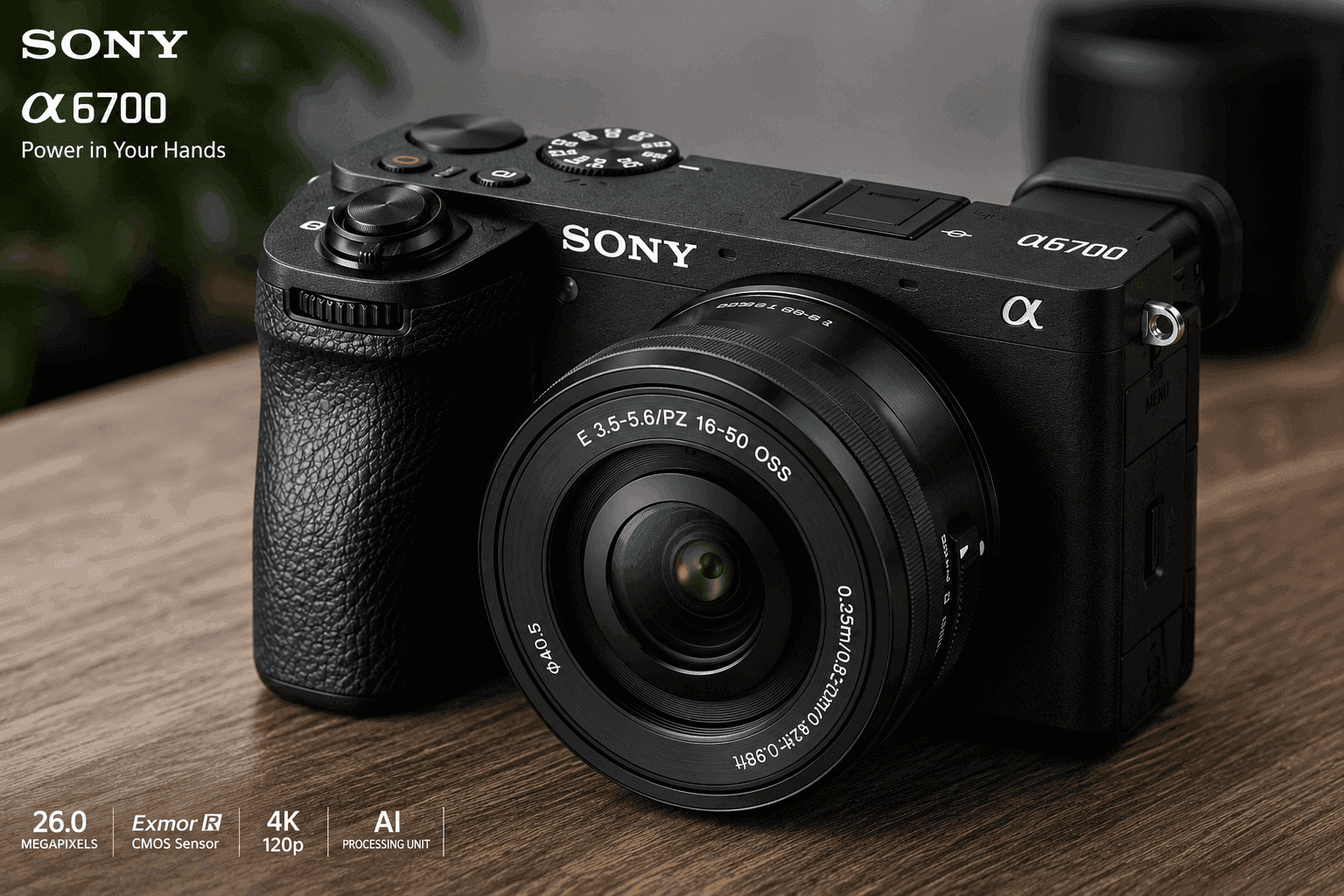
At the core of the Sony a6700 is a brand new 26.0-megapixel back-illuminated Exmor R CMOS sensor.
If you are familiar with the Sony FX30 cinema camera, you might recognize this sensor, as it shares much of the same architecture.
The jump from 24 megapixels to 26 might seem small on paper, but the “back-illuminated” part is where the real magic happens.
This design allows the sensor to capture more light more efficiently, which translates to better performance when you are shooting in dim environments like a candlelit dinner or a sunset landscape.
Because the sensor can gather more data with less noise, your images look cleaner, sharper, and more professional even when you have to push the ISO settings higher than usual.
Furthermore, this sensor is paired with the latest BIONZ XR processing engine.
This processor is significantly faster than the ones found in older models, allowing the camera to handle massive amounts of data in real time.
This speed is what enables the high-frame-rate video recording and the lightning-fast autofocus that we will discuss later.
When you press the shutter button on the Sony a6700, the communication between the sensor and the processor happens almost instantaneously, ensuring that you never miss a fleeting moment.
It provides a level of responsiveness that makes the camera feel like an extension of your own hand, reacting to the world just as fast as you do.
The Power of AI: Next-Generation Autofocus in the Sony a6700
One of the biggest selling points of the Sony a6700 is its dedicated AI processing unit.
In the past, autofocus systems relied mostly on contrast and phase detection to guess what the subject was.
However, the a6700 uses deep learning technology to actually “see” and “recognize” what it is looking at.
It doesn’t just look for a human eye; it understands the human form, recognizing heads, torsos, and limbs.
This means that even if a person turns their back to the camera or their face is obscured by a hat or glasses, the camera will maintain its focus lock on their body.
This level of reliability is a game-changer for event photographers who need to track subjects moving through a crowded room.
The AI doesn’t stop at humans, though. The Sony a6700 features expanded subject recognition for animals, birds, insects, cars, trains, and even airplanes.
For wildlife photographers, this is a massive upgrade. You can point the camera at a bird hiding behind branches, and the AI will prioritize the bird’s eye, ignoring the distracting leaves in the foreground.
The system is incredibly intuitive and customizable, allowing you to tell the camera exactly what to look for.
This reduces the number of blurry photos you take and allows you to focus more on the composition and the art of the shot rather than worrying about whether the technical settings are perfect.
4K Video Capabilities: A Filmmaker’s Dream in a Small Body
For content creators and videographers, the Sony a6700 is essentially a mini cinema camera.
It is capable of recording 4K video oversampled from 6K, which results in incredibly detailed footage with minimal noise.
But the real headline feature is the ability to shoot 4K at up to 120 frames per second.
This allows you to create buttery-smooth slow-motion shots that add a cinematic flair to your projects.
Whether you are filming a wedding dance, a sporting event, or a product commercial, having that high frame rate in a compact body gives you a massive creative advantage that used to be reserved for cameras costing twice as much.
Additionally, the Sony a6700 supports 10-bit 4:2:2 internal recording and includes the S-Cinetone color profile.
S-Cinetone is famous for producing beautiful, natural skin tones and a soft, film-like look right out of the camera without the need for heavy color grading.
For those who do like to grade their footage, S-Log3 offers over 14 stops of dynamic range, giving you the flexibility to recover highlights and shadows in post-production.
The inclusion of these high-end video features makes the a6700 a formidable tool for YouTube creators, documentary filmmakers, and anyone who wants their video work to stand out in a crowded digital world.
Designing for the User: Ergonomics and Build Quality
Sony has listened to user feedback over the years, and the design of the Sony a6700 reflects that evolution.
While it maintains the compact rangefinder style that the a6000 series is known for, it features a deeper, more comfortable grip.
This is a vital improvement, especially when you are using larger or heavier lenses; the deeper grip allows for a more secure hold, reducing hand fatigue during long shooting sessions.
The body is also constructed from magnesium alloy and is dust and moisture-resistant, meaning you don’t have to baby the camera when the weather takes a turn for the worse while you’re out in the field.
Another major physical improvement is the addition of more physical controls.
The Sony a6700 now includes a dedicated front dial, which allows you to change settings like aperture or shutter speed much more quickly than on previous models.
There is also a dedicated switch to toggle between Still, Movie, and S&Q (Slow and Quick) modes, ensuring that your settings for photography and videography remain separate and organized.
The fully articulating touchscreen monitor is another huge win, especially for vloggers or those who like to shoot from creative low or high angles.
It’s clear that Sony designed this camera to be as user-friendly as it is powerful.
In-Body Image Stabilization: Shooting Sharp Without a Tripod
Shaky footage and blurry photos are the enemies of every photographer. The Sony a6700 addresses this with a 5-axis in-body image stabilization (IBIS) system.
This system physically moves the sensor to compensate for the micro-shakes of your hands.
It provides up to 5 steps of stabilization, which is a lifesaver when you are shooting in low light and need to use a slower shutter speed.
It means you can often leave the tripod at home and still come back with tack-sharp images of a city at night or a dim forest interior.
For videographers, the Sony a6700 also includes an “Active Mode” stabilization.
This uses a slight crop of the sensor combined with the IBIS and digital processing to provide even smoother results while walking or moving.
While it doesn’t completely replace a dedicated gimbal for high-action scenes, it makes handheld vlogging much more professional-looking.
When you combine this stabilization with the AI-driven autofocus, you have a camera that is incredibly forgiving and capable of producing high-quality results even in challenging, unstable shooting conditions.
The Importance of Lens Selection for the Sony a6700
One of the greatest strengths of the Sony a6700 is that it uses the Sony E-mount system. This is one of the most mature and diverse lens ecosystems in the world.
Because the a6700 is an APS-C camera, you can use lenses specifically designed for the smaller sensor, which are typically lighter and more affordable.
Lenses like the Sony 16-55mm f/2.8 G offer professional-grade sharpness in a package that perfectly balances on the a6700 body.
If you are looking for something more budget-friendly, brands like Sigma and Tamron offer incredible prime and zoom lenses that perform beautifully with Sony’s autofocus system.
Furthermore, you can also use Sony’s full-frame (FE) lenses on the Sony a6700.
This gives you a clear path for future upgrades. If you eventually decide to move to a full-frame camera like the A7IV, your lenses will come with you.
Using a full-frame lens on an APS-C body also has the benefit of using the “sweet spot” of the glass—the center—which is usually where the lens is sharpest.
Whether you need a wide-angle lens for landscapes, a macro lens for close-ups of flowers, or a long telephoto lens for sports, the lens options for the a6700 are virtually limitless.
Creative Look Profiles: Styling Your Photos In-Camera
Not everyone wants to spend hours in front of a computer editing RAW files.
The Sony a6700 includes a variety of “Creative Look” presets that allow you to apply specific aesthetic styles to your photos and videos as you take them.
These aren’t just simple filters; they are sophisticated color profiles that adjust contrast, saturation, and tone.
You can choose a “Vivid” look for punchy landscapes, a “Soft High Key” for flattering portraits, or a “Monochrome” for classic black and white street photography.
These looks can be further customized to fit your personal taste, allowing you to develop a unique visual style without the need for complex software.
For the modern social media creator, this is a massive time-saver.
You can take a photo on the Sony a6700, transfer it to your smartphone using the Sony Creators’ App, and post it to Instagram or TikTok immediately, knowing that the colors and mood are already exactly where you want them.
This “straight out of camera” quality is a testament to how far Sony’s JPEG processing has come. It empowers creators to focus on the joy of capturing the moment rather than the chore of the digital darkroom.
Battery Life and Connectivity: Staying Powered and Linked
A camera is only useful if it’s powered up and ready to go. The Sony a6700 uses the larger Z-series battery (NP-FZ100), which is a significant upgrade over the smaller batteries used in the older a6000-series models.
This battery is known for its longevity, often lasting for hundreds of shots or hours of video recording on a single charge.
This means you can go out for a full day of shooting without constantly worrying about your battery percentage or carrying a pocket full of spares.
When you do need to charge, the camera supports USB-C PD (Power Delivery), allowing for fast charging directly in the camera.
In terms of connectivity, the Sony a6700 is built for the modern world. It features built-in Wi-Fi and Bluetooth, making it easy to sync with your phone or tablet.
The Sony Creators’ App is a significant improvement over previous software, offering a stable connection for transferring files or controlling the camera remotely.
You can use your phone as a remote shutter or a secondary monitor, which is perfect for group photos where you want to be in the shot.
The camera also supports UVC/UAC standards, meaning you can plug it into a computer via USB and use it as a high-end webcam for streaming or Zoom calls without needing any extra hardware.
The Sony a6700 for Wildlife and Sports Photography
Speed is the name of the game when it comes to sports and wildlife.
The Sony a6700 delivers with a mechanical shutter speed of up to 11 frames per second with full autofocus and auto-exposure tracking.
While some flagship cameras offer higher numbers, 11 fps is more than enough to capture the peak of a jump or a bird taking flight.
The real secret weapon here is the buffer; the camera can clear its memory quickly, so you aren’t left waiting while the camera “thinks” after a long burst of shots.
The APS-C sensor also provides a “crop factor” of 1.5x. This means that a 200mm lens on the Sony a6700 gives you the equivalent reach of a 300mm lens on a full-frame camera.
This extra reach is a huge benefit for wildlife photographers who can’t always get close to their subjects.
You get more “pixels on target,” allowing you to see fine details like feathers or fur that might be lost on other systems.
When you combine this reach with the AI-driven bird and animal tracking, the a6700 becomes one of the best value-for-money options for nature enthusiasts.
Audio Performance: Getting Professional Sound
We often say that audio is 50% of the viewing experience in video, and the Sony a6700 doesn’t neglect this.
It features a standard 3.5mm microphone jack for external mics and a headphone jack for monitoring your audio levels in real time.
However, the real standout feature is the Multi-Interface (MI) Shoe on top of the camera.
This shoe supports digital audio interfaces, allowing you to use Sony’s proprietary shotgun mics or wireless systems without needing any cables.
This results in a cleaner setup and better sound quality because the signal stays digital from the microphone all the way into the camera’s processor.
Having clear, crisp audio is what separates amateur videos from professional content.
Whether you are conducting an interview in a noisy cafe or recording the sounds of nature, the Sony a6700 gives you the tools to capture high-fidelity sound.
The internal microphones are also surprisingly good for casual use, featuring wind-noise reduction that helps when you are filming outdoors.
For a camera this small, the level of audio control and flexibility is truly impressive.
Low Light Performance: How the Sony a6700 Handles the Dark
Many people assume that you need a massive full-frame sensor to get good photos in the dark, but the Sony a6700 challenges that assumption.
Thanks to the back-illuminated sensor design and the advanced noise reduction algorithms in the BIONZ XR processor, this camera performs exceptionally well at high ISO settings.
You can comfortably shoot at ISO 3200 or even 6400 and still get images that are detailed and printable.
This opens up a world of possibilities for evening street photography or indoor events where flash photography isn’t allowed.
The autofocus also remains remarkably sticky in low-light conditions. The AI processing unit can identify subjects even when the light levels drop significantly, ensuring that your night shots are focused perfectly.
While a full-frame camera will always have a slight edge in extreme darkness, the Sony a6700 narrows the gap significantly, making it a viable tool for almost any lighting situation you might encounter on your travels or in your daily life.
Navigating the Menus: A Much-Needed Interface Overhaul
Older Sony cameras were often criticized for having confusing, overly complex menu systems.
The Sony a6700 features the new, touch-responsive menu system that was first introduced in the A7S III.
This system is organized into color-coded categories with a logical flow, making it much easier to find the settings you need.
You can use the touchscreen to swipe through menus and select options, just like you would on a smartphone.
This makes the learning curve much shallower for beginners while still providing the deep customization that pros require.
You can also set up a “My Menu” tab, where you store your most-used settings for quick access.
Want to quickly toggle the interval timer for a timelapse? Or switch the animal eye-AF from “Bird” to “Dog”? You can put all those functions in one place.
The Sony a6700 is designed to get out of your way and let you focus on the creative process.
The combination of the improved physical dials and the intuitive touch interface makes operating this camera a smooth and enjoyable experience.
Comparing the Sony a6700 to the Competition
When looking at the Sony a6700, it’s important to see how it stacks up against its rivals, like the Fujifilm X-T5 or the Canon EOS R7.
While each camera has its strengths, the a6700 wins out for many because of its industry-leading autofocus and the sheer size of the E-mount lens library.
While Fujifilm might offer more “vintage” styling and film simulations, Sony’s AI tracking is generally considered more reliable for moving subjects.
Canon’s R7 is a strong contender for sports, but its lens selection for APS-C sensors is currently much more limited than Sony’s.
The Sony a6700 occupies a “sweet spot” in the market. It offers the best of Sony’s full-frame technology in a smaller, more affordable package.
For someone who wants a hybrid camera that is equally good at photos and video, the a6700 is very hard to beat.
It doesn’t try to be a specialized tool for just one thing; instead, it aims to be the best all-arounder for the modern content creator, and in that regard, it succeeds brilliantly.
Who Should Buy the Sony a6700?
The Sony a6700 is a versatile tool that fits many different types of photographers.
If you are a travel photographer who wants the best possible image quality in a backpack-friendly size, this is the camera for you.
If you are a YouTuber who needs a reliable camera for vlogging and product shots, this is the camera for you.
Even if you are a professional photographer who already owns a full-frame Sony kit, the a6700 makes for an incredible second body or a lightweight alternative for days when you don’t want to carry a heavy gear bag.
It is also an excellent choice for students or serious beginners who want a camera they can grow into.
Because it shares so many features with Sony’s professional line, the skills you learn on the Sony a6700 will translate directly to higher-end gear later on.
It is a camera that won’t hold you back as your creativity grows.
Instead, it will provide you with the tools and the confidence to explore new genres of photography and videography, from macro to astro-photography and everything in between.
Final Verdict: Is the Sony a6700 Worth It?
After looking at all the features, performance benchmarks, and design choices, the conclusion is clear: the Sony a6700 is a triumph.
It successfully bridges the gap between the enthusiast and professional worlds. By bringing AI-powered autofocus, 10-bit 4K video, and improved ergonomics to the APS-C format, Sony has revitalized its crop-sensor lineup.
It is a camera that feels modern, capable, and, most importantly, fun to use.
It removes the technical barriers between your vision and the final image, allowing you to capture the world exactly as you see it.
The Sony a6700 is more than just a spec sheet; it is a reliable companion for your creative journey.
Whether you are capturing the laughter of a friend, the majesty of a mountain range, or the fast-paced action of a street parade, this camera delivers results that you will be proud to share.
If you are in the market for a new camera that offers the latest technology without the massive price tag of a full-frame flagship, the a6700 should be at the very top of your list.
It is, quite simply, the new king of the APS-C mirrorless world.
The Sony a6700 stands as a testament to how far mirrorless technology has come, offering a perfect blend of AI-driven intelligence, stunning 4K video, and robust build quality.
It is a versatile powerhouse designed to empower creators of all levels to capture their world with unparalleled precision and ease.