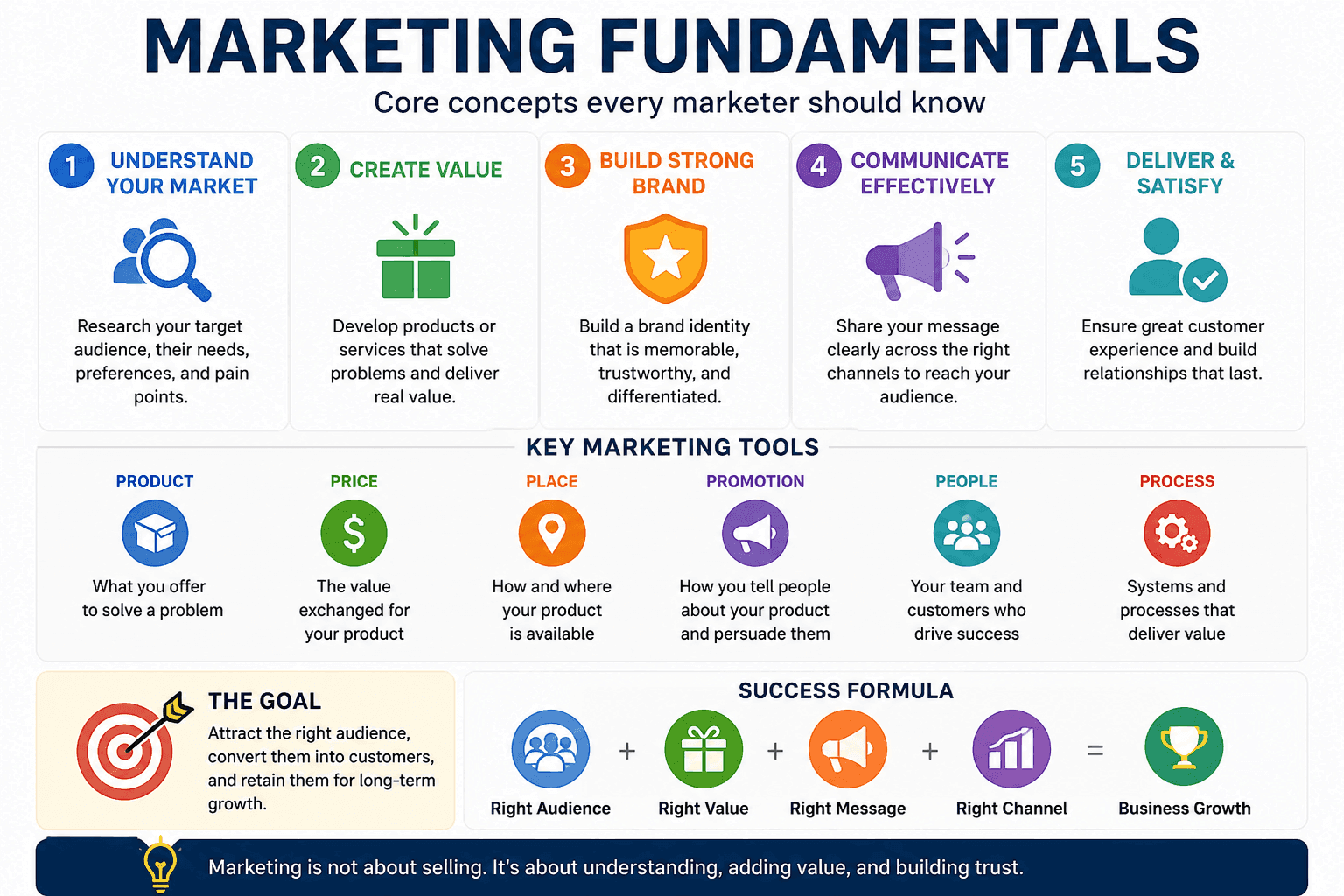
1. What Are Marketing Fundamentals?
Marketing fundamentals are the core principles that guide how a business finds customers, understands their needs, creates value, and communicates that value in a clear way.
Many people think marketing only means advertising, posting on social media, or making a nice logo, but it is much more than that. Marketing starts before a product is sold.
It begins with research, planning, understanding the audience, setting prices, choosing the right message, and building trust. When a business understands these fundamentals, it can make better decisions instead of guessing what customers want.
Good marketing is not about shouting the loudest; it is about saying the right thing to the right people at the right time.
2. Why Marketing Fundamentals Matter
Marketing fundamentals matter because they help businesses avoid random actions and wasted money.
Without a clear marketing base, a company may spend money on ads, content, packaging, or promotions without knowing whether those actions will bring results.
For example, a business may create a product it loves, but if customers do not need it or understand it, sales will be weak.
The fundamentals help answer important questions such as who the customer is, what problem the product solves, why people should choose it, and how the business should reach them.
A strong foundation makes every marketing activity more focused, more useful, and more likely to succeed.
3. Understanding Your Target Audience
One of the most important marketing fundamentals is knowing your target audience. Your target audience is the group of people most likely to buy from you.
These people may share similar needs, problems, interests, income levels, locations, or lifestyles. If you try to sell to everyone, your message often becomes too general and weak.
A small business selling baby clothes should not speak the same way as a company selling business software. Each audience has different emotions, questions, and buying reasons.
Understanding your audience helps you choose better words, better offers, better images, and better platforms. The more clearly you know your customer, the easier it becomes to connect with them.
4. Customer Needs and Problems
Marketing works best when it starts with a real customer need or problem. People usually buy something because it helps them save time, feel better, make money, reduce stress, look good, stay safe, learn something, or solve a problem.
A successful business does not only talk about product features; it explains how those features help the customer.
For example, a mattress company should not only say the mattress has memory foam.
It should explain that the mattress helps people sleep better and wake up with less body pain.
This is a key part of marketing fundamentals because customers care most about what a product does for them.
5. The Importance of Market Research
Market research means collecting information about customers, competitors, trends, prices, and buying habits.
This can be done through surveys, interviews, reviews, social media comments, website data, competitor analysis, and customer feedback.
Market research helps businesses make smarter decisions because it replaces guessing with real information.
For example, if many customers complain that similar products are too expensive, a business may create a more affordable option.
If people want faster delivery, the business can improve shipping. Research does not always need to be complicated or expensive.
Even reading customer reviews in your industry can teach you what people love, hate, and expect.
6. The 4 Ps of Marketing
The 4 Ps are one of the most famous marketing fundamentals. They stand for Product, Price, Place, and Promotion. Product means what you sell and how it solves a customer problem.
Price means how much customers pay and whether they see the offer as valuable. Place means where customers can find or buy the product, such as a store, website, app, marketplace, or social media page.
Promotion means how you tell people about the product through ads, content, emails, events, or other channels. These four areas work together. If one part is weak, the whole marketing plan can suffer.
7. Product: What Are You Really Selling?
A product is not only a physical item or service. It is the full value a customer receives. This includes quality, design, packaging, support, warranty, ease of use, and emotional benefit.
For example, a coffee shop is not only selling coffee. It may also be selling comfort, a peaceful space, friendly service, and a daily routine. A fitness coach is not only selling workout plans.
They may be selling confidence, health, discipline, and motivation. When learning marketing fundamentals, it is important to understand the deeper value behind your offer.
People often buy based on feelings and then justify the purchase with logic.
8. Price: More Than Just a Number
Price is a powerful part of marketing because it affects how people see your product.
A very low price may attract budget buyers, but it can also make some people question quality.
A high price can create a premium image, but only if the product, service, and brand support that value.
Pricing should be based on costs, customer expectations, competitor prices, demand, and perceived value.
Perceived value means what the customer believes the product is worth.
For example, a handmade leather bag may cost more than a factory-made bag because customers see more craftsmanship and uniqueness.
Good pricing is not only about being cheap; it is about being fair and valuable.
9. Place: Where Customers Find You
Place means how and where customers access your product or service. In the past, this often meant a physical store.
Today, place can include websites, mobile apps, online marketplaces, delivery platforms, social media shops, local offices, events, and distributors.
The right place depends on customer behavior.
If your audience shops online, your website and checkout process must be smooth.
If your audience prefers local service, your location, map listing, and phone number must be easy to find.
A great product can lose sales if customers cannot easily buy it.
Convenience is a major part of modern marketing fundamentals.
10. Promotion: How You Share Your Message
Promotion is how you tell people about your product, service, or brand.
This can include advertising, social media posts, blog articles, email campaigns, videos, public relations, influencer partnerships, discounts, and events.
Good promotion is not just about being visible. It must be clear, honest, and useful.
If your message is confusing, people may ignore it.
If your message makes big promises but the product does not deliver, customers may lose trust.
Strong promotion focuses on the customer’s problem, explains the solution, and gives a clear next step.
The best promotional messages feel helpful instead of pushy.
11. Branding and Trust
Branding is another important part of marketing fundamentals. A brand is more than a logo, color, or name.
It is the feeling people have when they think about your business. A strong brand creates trust, recognition, and loyalty.
Customers are more likely to buy from a business they remember and believe in.
Branding includes your voice, values, design, customer service, quality, and consistency.
For example, if a brand says it is friendly and simple, its website, emails, support team, and packaging should all feel friendly and simple.
Trust grows when a business acts the same way across every customer touchpoint.
12. Positioning: Why Should Customers Choose You?
Positioning means the place your brand holds in the customer’s mind.
It answers the question: why should someone choose you instead of a competitor? Your position may be based on price, quality, speed, design, service, experience, location, or specialty.
For example, one restaurant may position itself as a low-cost family place, while another may position itself as a luxury dining experience. Both can succeed, but they must speak to different customers.
Clear positioning helps your business stand out.
If customers cannot quickly understand what makes you different, they may choose a competitor that explains its value better.
13. Customer Journey
The customer journey is the path a person takes from first hearing about your business to becoming a buyer and possibly a loyal customer.
This journey usually includes awareness, interest, consideration, purchase, and retention. At the awareness stage, people discover your brand.
At the interest stage, they want to learn more. At the consideration stage, they compare you with other options. At the purchase stage, they decide to buy.
At the retention stage, they may return, leave reviews, or recommend you to others.
Understanding this journey helps you create the right message for each step.
Not everyone is ready to buy immediately, so marketing should guide people patiently.
14. Content Marketing Basics
Content marketing means creating helpful information that attracts and supports your audience.
This can include blog posts, videos, guides, podcasts, infographics, case studies, newsletters, and social media content.
Content is useful because people often search for answers before they buy.
For example, a skincare brand can publish articles about dry skin, acne care, or sunscreen tips.
This helps customers learn while also building trust in the brand. Good content should be simple, honest, and useful.
It should not only promote products all the time. The best content answers real questions and helps people make better choices.
15. Digital Marketing Channels
Modern marketing fundamentals include understanding digital channels. These are online places where businesses connect with customers.
Common channels include search engines, social media, email, websites, paid ads, online communities, and video platforms.
Each channel has a different purpose. Search is useful when people are actively looking for answers.
Social media is useful for awareness, community, and engagement. Email is useful for building relationships and repeat sales.
Paid ads can bring faster visibility. A business does not need to use every channel at once.
It should choose the channels where its audience spends time and where the message fits naturally.
16. Social Media Marketing
Social media marketing helps businesses communicate with people in a more personal way.
Platforms like Facebook, Instagram, TikTok, LinkedIn, X, Pinterest, and YouTube can help brands share stories, answer questions, show products, and build communities. However, social media is not only about posting every day.
It requires a clear plan, useful content, and real engagement. Businesses should avoid sounding robotic or overly sales-focused.
People use social media to connect, learn, and be entertained.
A good social media strategy mixes education, personality, proof, and offers. It should make people feel like there are real humans behind the brand.
17. Email Marketing
Email marketing is still one of the most effective ways to stay connected with customers.
Unlike social media, where algorithms control who sees your posts, email gives you a more direct line to your audience.
Businesses can use email to share helpful tips, offers, updates, product launches, reminders, and customer stories.
The key is to send emails that people actually want to read. Too many sales emails can make people unsubscribe.
A good email plan offers value first and sells in a natural way.
Personal subject lines, clear writing, and useful content can improve results.
18. Marketing Analytics and Measurement
Marketing without measurement is like driving without a map.
Analytics help businesses understand what is working and what needs improvement.
Important metrics may include website visits, leads, sales, email open rates, ad clicks, conversion rates, social media engagement, customer retention, and return on investment.
These numbers help you make better decisions.
For example, if many people visit your website but few buy, your product page or checkout process may need improvement.
If an ad gets clicks but no sales, the message may attract the wrong audience.
Measurement is one of the marketing fundamentals that turns activity into learning.
19. Customer Retention
Many businesses focus only on getting new customers, but keeping existing customers is just as important.
Customer retention means encouraging people to buy again and stay loyal to your brand.
This can be done through great service, follow-up emails, loyalty programs, special offers, helpful support, and consistent product quality.
It is often cheaper to keep a customer than to find a new one. Happy customers may also recommend your business to friends and family.
Retention shows that marketing does not end after the sale.
The experience after purchase can decide whether a person becomes a one-time buyer or a long-term supporter.
20. Common Marketing Mistakes to Avoid
Many businesses struggle because they skip the basics.
Common mistakes include trying to target everyone, copying competitors, ignoring customer feedback, using unclear messages, focusing only on discounts, posting without a plan, and not measuring results.
Another big mistake is expecting instant success. Marketing takes time, testing, and patience.
A campaign may not work the first time perfectly, but every result teaches something.
Businesses should also avoid making promises they cannot keep.
Trust is hard to build and easy to lose.
Strong marketing fundamentals help prevent these mistakes by keeping the focus on customers, value, and consistency.
21. How to Build a Simple Marketing Plan
A simple marketing plan does not need to be complicated. Start by writing down your business goal.
Then define your target audience, main message, offer, channels, budget, and success metrics.
For example, your goal may be to get 100 new leads in three months. Your audience may be local homeowners.
Your message may focus on saving time and improving home comfort.
Your channels may include local search, social media, email, and customer referrals.
Your success metrics may include calls, form submissions, and booked appointments.
A written plan helps you stay focused and avoid random decisions.
Final Thoughts
Marketing fundamentals are the foundation of every strong business strategy.
They help you understand your customers, create real value, choose the right message, and reach people in the right way.
Marketing is not only about promotion; it is about solving problems, building trust, and creating long-term relationships.
If you focus on the basics—audience, product, price, place, promotion, branding, content, measurement, and customer experience—you can make smarter decisions and grow with more confidence.
The best marketing feels natural, helpful, and honest because it is built around real people and real needs.